Date: 5th to 7th June 2026
| Project theme | Restoring River Rwizi Catchment, Creating inpact. |
| Location | Rwentango, River Rwizi Catchment, Isingiro District, Western Uganda |
| Organized by | Avian Conservation Uganda in partnership with Rotaract Club of Kampala Maisha |
| Supported by | Nile Breweries Limited |
| Project leaders | Namara Dismus, CEO, Avian Conservation Uganda; Kusiima Pius, President, Rotaract Club of Kampala Maisha |
| Main activities | Tree planting, community engagement and birding. |
Executive Summary
This report details the successful planting of over 50 bamboo trees in the Rwentango area of the River Rwizi basin, a joint effort by Avian Conservation Uganda (ACUG), Nile Breweries Ltd and the Rotaract Club of Kampala Maisha, hosted at Rwetango Tourism Centre (Nyakahita, Isingiro). Over this weekend, our team planted more than 5 bamboo saplings along the Rwetango stretch of River Rwizi to stabilize eroded riverbanks and rebuild riparian habitat. The activity engaged ACUG staff and, Rotaract members and local community landowners. Key outcomes include more than 50 bamboo seedlingsplanted, community volunteers mobilized, and increased awareness of river conservation. The project advanced ACU’Gs mission to restore ecosystems and “promote sustainable coexistence” between wildlife and communities, aligning with Nile Breweries’ water stewardship goals and Rotaract’s environmental service focus. Local landowners (e.g. Mr Eriya Barujwara, MrsKembabazi Beatrice, Mr.Zedekiah Kotunga) donated riverside land for planting.
1. Introduction/Background
River Rwizi (Rwizi means “big water”) is a 270 km river in SW Uganda, supplying water to over 2.5 million people, including Mbarara City and industries like Nile Breweries.(WWF 2024) The river flows through about 13 districts, supplying water to communities, farms, and businesses. In recent decades the Rwizi basin has suffered severe degradation due to climate change, deforestation and pollution (urban sewage, unsustainable agriculture, sand mining, and encroachment along its banks. National Water and Sewage Corporation (NWSC) estimate that as much as 60-80% of the river’s flow has been lost to irrigation and other withdrawals, causing sections of the channel to dry up seasonally. The loss of river volume has exposed the riverbed and increased erosion. As a result, downstream users (including fishing and tourism) face water shortages. To address these issues, Avian Conservation Uganda and partners conducted a restoration and tree-planting project in June 2026 at Rwentango, within the Rwizi corridor. This activity aimed to stabilize the riverbanks with vegetation, improve river health, and engage the local community in conservation practices.
2. About Avian Conservation Uganda
Avian Conservation Uganda is youth-led nonprofit organization dedicated to preserving the country’s birdlife and habitats. Led by the CEO Namara Dismus (a graduate of Environmental Science and Management with a master’s in Conservation Biology), We works with communities to restore ecosystems. The organization implements field-based projects (like habitat restoration, bird monitoring, and environmental education) to address climate change and biodiversity loss.
3. About Nile Breweries Limited
Nile Breweries Limited (NBL) is a leading beverage manufacturer in Uganda and part of the AB InBev family. NBL has a flagship sustainability program that emphasizes climate action, water stewardship, and community development. Through its parent company AB InBev, Nile Breweries commits resources to tree-planting initiatives and climate-smart agriculture as part of its global goals. As a partner in this project, Nile Breweries provided funding for the River Rwizi restoration activities. The company is commited to continous support of this initiatives and its sustainability.
4. About Rotaract Club of Kampala Maisha
The Rotaract Club of Kampala Maisha is a young professional and student volunteer organization affiliated with Rotary International. Its members engage in community service projects focusing on youth empowerment, education, and local development. The current club president, Mr. Kusiima Pius, led Rotaract members in this river restoration project. Club members participated alongside Avian and Nile Breweries staff, lending manpower and outreach capacity to the event.
5. River Rwizi Conservation Context
The River Rwizi basin is a key natural resource. It supports agriculture (including rice farms), fisheries, and domestic water needs for cities such as Mbarara. However, unchecked farming, livestock grazing, and settlement along the river banks have accelerated soil erosion and sedimentation. Over the past two decades, the river’s flow has diminished and water levels have fallen by roughly 60-80% from historical averages, due to over-extraction and changing rainfall patterns. As riparian vegetation is lost, the soil that once held the banks intact washes downstream, carrying nutrients and pollutants. This not only threatens the local ecosystem but also the livelihoods of the communities that depend on Rwizi’s water. Bamboo was selected for this project because of its ability to quickly form dense roots and stems, which help stabilize soil and retain moisture along eroded banks.
6. Objectives
The specific objectives of the River Rwizi restoration activity were:
| No. | Objective | Explanation |
| 1 | Prevent soil erosion along the riverbanks | Bamboo has strong and extensive root systems that bind soil together. Once established, the roots help hold riverbank soil in place, reduce surface run off, and protect the bank from being washed away during rains. |
| 2 | Filter water and trap solid debris | Dense bamboo stands slow down moving water near the banks and trap leaves, silt, and other solid debris before they enter the river channel. This helps reduce sediment load and supports cleaner water flow. |
| 3 | Support riverbank restoration and habitat improvement | Bamboo creates a protective vegetative cover that stabilizes degraded banks, improves microhabitats, and helps restore the natural buffer that protects the river from direct human pressure. |
| 4 | Contribute to climate change mitigation | Bamboo grows fast and captures carbon efficiently because it is a C4 plant. By taking carbon dioxide from the atmosphere, it helps reduce the pressure that drives global warming. |
| 5 | Provide a useful and fast growing conservation species | Bamboo is valuable because it grows quickly, can be established in degraded areas, and can be used sustainably while still supporting ecological restoration. |
7. Activities Implemented
7.1 Tree Planting Activity
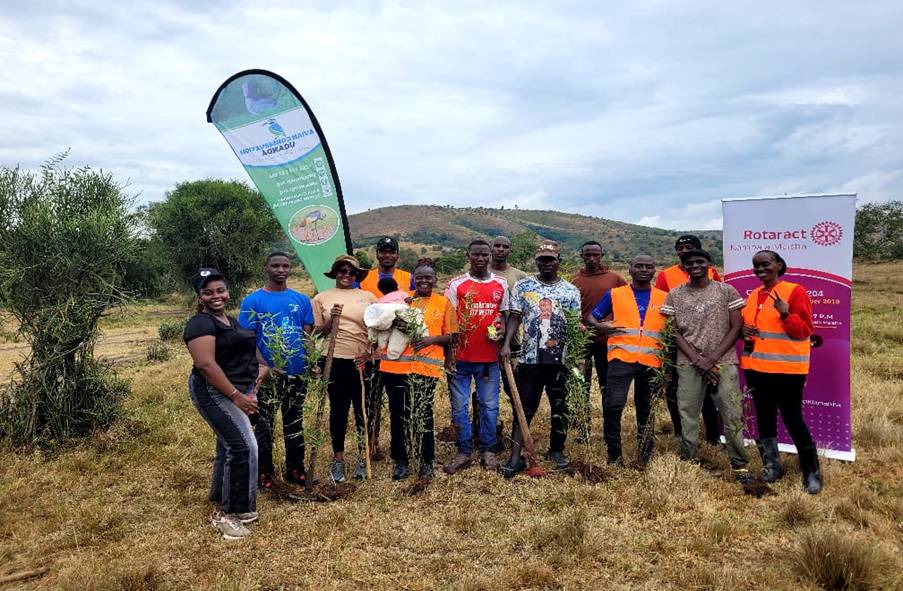
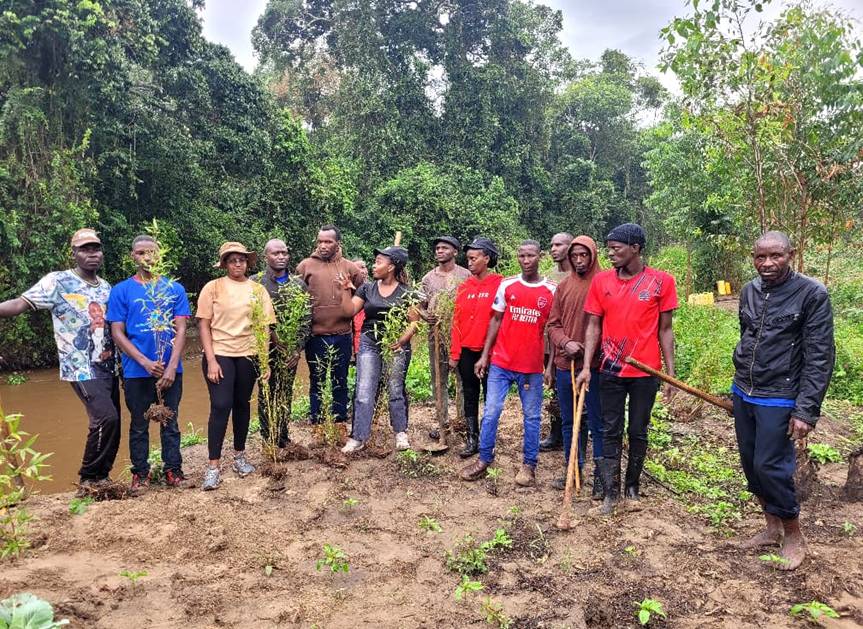
The core activity was the planting of over 50 bamboo saplings along vulnerable sections of the Rwizi riverbank near Rwentango. This involved digging planting pits, positioning the bamboo plants,and watering the newly-planted seedlings. Participants included Avian and Rotaract members as well as community members (including local farmers who had provided land for the project). The team worked under the guidance of project leaders to ensure each bamboo was planted correctly for maximum survival.
7.2 Birding Activity
As part of raising ecological awareness, the project also featured guided bird-watching along the river corridor. Avian Conservation Uganda staff led volunteers to identify native birds and discuss their habitat needs. This activity helped participants connect with the biodiversity of the wetland environment and understand how habitat restoration benefits local wildlife.
7.3 Community Engagement
Throughout the project, the organizers engaged with community members, especially local landowners and leaders. Before and after field work, the team held discussions explaining the benefits of the river restoration measures. Local elders (including Mzee Eriya Barujwara, Mrs Kembabazi Beatrice, and Mr. Zedekiah Kotunga, who each donated land) were formally thanked for their contributions. Engineer Salome Kasiisi Ajuna of the Rwentango tourism center hosted the team and facilitated logistics (providing accommodation and meals over the two days).
8. Results and Achievements
The project successfully planted more than 50 bamboo trees along the riverbanks. These plants now serve as live barriers to slow runoff and stabilize the soil. The collaborative effort demonstrated strong volunteer engagement: participants included four Rotaract club members and Avian staff working alongside farmers. The awareness activities (birding and community meetings) reinforced knowledge about the river ecosystem. One outcome was formal commitments from landowners to maintain the bamboo on their property. Although long-term monitoring will be needed to measure impact, the initial outcome is that a vulnerable stretch of Rwizi is now better protected against erosion and sediment flow.
9. Stakeholder Engagement
This project exemplified a multi-stakeholder partnership. Avian Conservation Uganda led the project design and field implementation. Nile Breweries Limited provided financial support and plant materials. The Rotaract Club of Kampala Maisha contributed volunteer manpower and youth outreach. Local landowners (such as Mzee Eriya Barujwara, Mrs. Kembabazi Beatrice, Mr.Zedekiah Kotunga) and community leaders welcomed the project and offered land for planting. Such engagement ensured that actions were locally appropriate and that community members had a sense of ownership of the restoration efforts.
10. Challenges
| Challenge | Suggested Solution |
| The area was remote and the roads made transportation difficult. | Use strong four wheel drive vehicles and plan transport early so that people and materials reach the site on time. |
| Some tree planting sites were bushy and hard to access. | Prepare the site before the activity day by clearing the planting points in advance. |
| The river is long and requires many bamboo seedlings, but seedlings are expensive. | Mobilize more funding and plan for a larger tree planting campaign to cover more sections of the riverbanks. |
11. Lessons Learned
- Early Engagement is Crucial: Securing landowner commitment (Barujwara, Tumukunde, Kootunga) before planting made a big difference. Community co-ownership motivates maintenance.
- Bamboo Works: Our field observations confirmed that bamboo is a suitable choice for riverbank stabilization and quick growth. We saw initial survival of planted shoots by day’s end.
- Power of Partnerships: The combination of ACU’s expertise, Rotaract’s manpower, Nile’s funding and Rwetango’s facilities was effective. No single partner could have achieved this alone.
- Need for Monitoring: We realized the importance of follow-up. Planting is just step one; tracking survival rates and grazing impact will determine success.
12. Recommendations and Action Plan
| Recommendation | Action Steps | Lead | Timeline |
| Scale up Riparian Planting: Increase the number and area of bamboo plantings along Rwizi. | Seek additional funding (e.g. Nile Brewers, Rotary clubs, grants)Procure 200+ bamboo seedlings for next planting – Plan staged plantings upstream and downstream of Rwetango. | ACU (with Rotaract support) | Start immediately; next planting in 3-6 months |
| Strengthen Community Stewardship: Empower locals to sustain the project. | – Form a “River Guardians” group of volunteers for maintenance – Provide simple training (e.g. watering, weeding) – Install fencing or natural barriers with farmer help. | ACU & Village Leaders | Ongoing (quarterly check-ins) |
13. Acknowledgements
This project would not have been possible without the contributions of many individuals and organizations. We thank the leadership of Avian Conservation Uganda (especially Namara Dismus) and the Rotaract Club of Kampala Maisha (led by Kusiima Pius) for their commitment. Our gratitude also goes to Nile Breweries Limited for funding and logistical support. We are grateful to Engineer Ajunu of the Rwentango Tourism Center for hosting the team and providing accommodations and meals. Special thanks to Mzee Eriya Barujwara, MrsKembabazi Beatrice, Mr.Zedekiah Kotunga for generously donating portions of their land for the plantings. Additional thanks to all community members, volunteers, and government officials who supported this activity.
14. Conclusion
The River Rwizi restoration activity at Rwentango achieved its immediate goal of establishing new vegetation along the banks and engaging stakeholders. It demonstrated how a partnership between an NGO, a private company, volunteers, and local communities can address environmental challenges. Though this was a small-scale intervention, it provides a model for similar efforts in other parts of the river basin. Continued collaboration and follow-up actions will be necessary to sustain river health and adapt to future climate conditions. Avian Conservation Uganda and its partners are committed to building on this success to ensure the long-term recovery of the River Rwizi ecosystem.
15. Photo Captions (Placeholder)
Figure 1: Members from Avian Conservation Uganda,Rotaract club of Kampala Maisha and some community members in Rwentango After the tree planting
Figure 2: During the tree planting.
Link to project photos: Sure!
https://photos.app.goo.gl/n4wKEdw2pm4QzHcC7
Annex A: Preserved Facts
| Fact | Source (Original Notes) |
| Over 50 bamboo trees planted | User’s original project notes |
| River Rwizi is approximately 270 km long | NWSC,WWF,Nili Breweries |
| River Rwizi flows through about 13 districts | WWF,NEMA |
| 60-80% of Rwizi’s water has been lost to irrigation/use | NWSC |
| Namara Dismus (Avian Conservation Uganda) | User’s original project notes |
| Kusiima Pius (Rotaract Club president) | User’s original project notes |
| Engineer Ajunu (Rwentango tourism center) | User’s original project notes |
| Mzee Baarujwara (land donor) | User’s original project notes |
| MrsKembabazi Beatrice, (land donor) | User’s original project notes |
| Mr.Zedekiah Kotunga (land donor) | User’s original project notes |
All contributors to this cause;