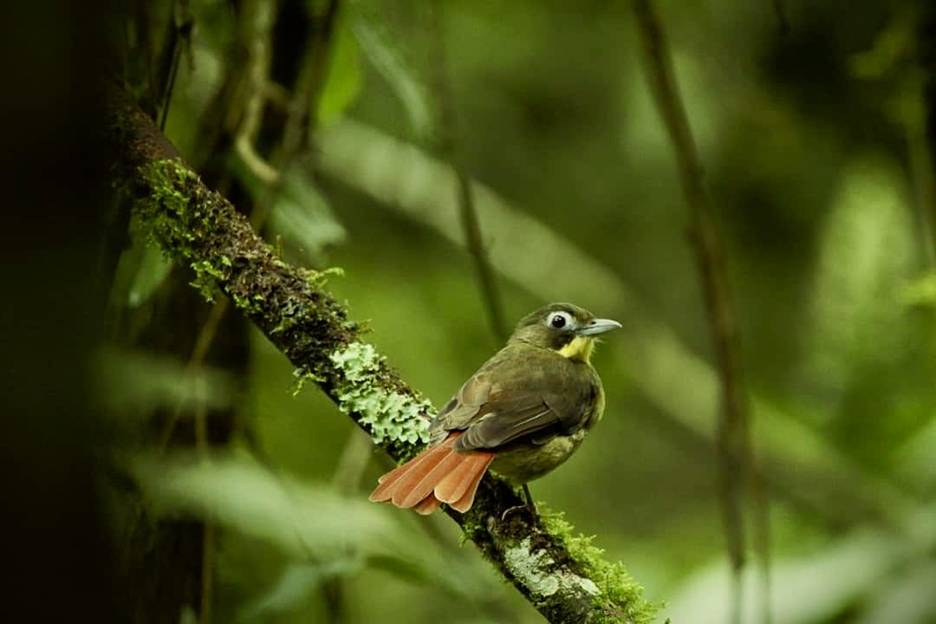
Red-tailed Bristlebill

Conservation Status:

The Red-tailed Bristlebill is currently classified as Least Concern on the IUCN Red List due to its relatively wide distribution across West and Central Africa and the absence of major global threats.

Population Trends:

The global population trend is considered stable, although localized declines may occur where forests are degraded or cleared.

Population Size:

No precise global population estimate is available. However, the species is generally regarded as fairly common within suitable forest habitats across its range.

Family:

The Red-tailed Bristlebill belongs to the Pycnonotidae family, a diverse group of birds commonly known as bulbuls.

Location:

In Uganda

Habitat:

The Red-tailed Bristlebill occurs mainly in tropical lowland and medium-altitude forests, including forests in western Uganda. It favors dense undergrowth, forest edges, secondary forest, and thickets, where it feeds on insects, fruits, and other small food items.

Migration Pattern:

The Red-tailed Bristlebill is non-migratory (resident).

Migration Distance:

It remains within forest habitats throughout the year and does not undertake long-distance migrations. Any movements are usually local and limited, often related to food availability.
Red-tailed Bristlebill

About this Bird:

A Secretive Jewel of Uganda’s Forests.

The Red-tailed Bristlebill (Bleda syndactylus) is a shy and attractive forest bird known for its olive-brown plumage, bright reddish tail, and distinctive bristles around the base of its bill. It belongs to the Pycnonotidae family, the bulbuls, and is most often found in the dense undergrowth of tropical forests.

Conservation Importance

As a forest-dependent species, the Red-tailed Bristlebill serves as an indicator of healthy woodland and rainforest ecosystems. Protecting Uganda’s forests helps conserve this species and many other birds that depend on intact forest habitats. Though often hidden from view, the Red-tailed Bristlebill contributes to the rich biodiversity of Uganda’s forests and reminds birdwatchers that some of the most fascinating species are found deep within the forest understory.

More Birds