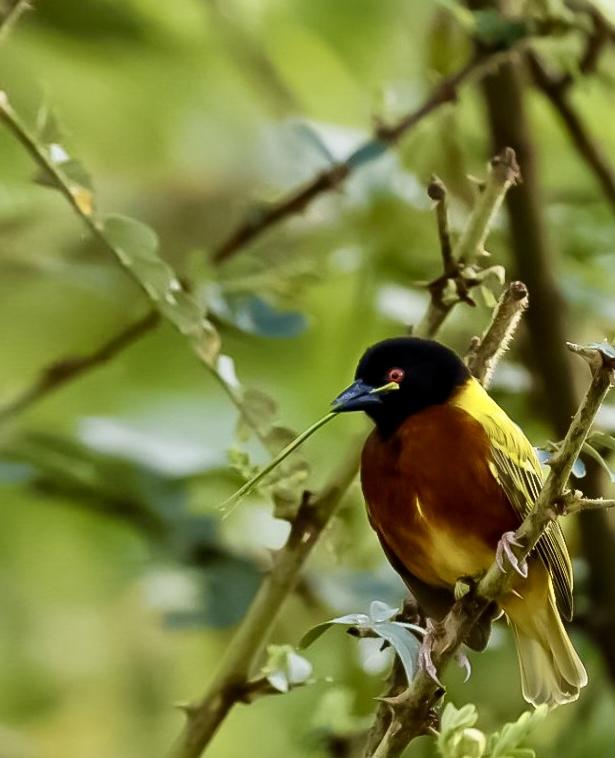
Golden-backed Weaver

Conservation Status:

The Golden-backed Weaver is currently classified as Least Concern on the IUCN Red List due to its relatively wide distribution and healthy population levels.

Population Trends:

The global population trend is considered stable. The species remains common in suitable habitats throughout its range in East Africa.

Population Size:

Although there is no precise global population estimate, the Golden-backed Weaver is considered locally common to common in areas where suitable nesting and feeding habitats exist.

Family:

The Golden-backed Weaver belongs to the Ploceidae family, a group of birds famous for their remarkable nest-building abilities and colonial breeding behavior.

Location:

In Uganda

Habitat:

The Golden-backed Weaver is commonly found in papyrus swamps, wetlands, lakeshores, riverbanks, marshes, and areas with dense waterside vegetation. It is particularly associated with reedbeds and wetland habitats where colonies can safely construct nests above water. The species feeds on seeds, grains, insects, and other small invertebrates, making it an important component of wetland ecosystems.

Migration Pattern:

The Golden-backed Weaver is non-migratory (resident).

Migration Distance:

It does not undertake long-distance migrations but may make short local movements in response to rainfall, breeding opportunities, and food availability.
Golden-backed Weaver

About this Bird:

The Brilliant Architect of Uganda’s Wetlands.

Photo By: Precious a bird guide in Uganda.

The Golden-backed Weaver (Ploceus jacksoni), often referred to as Jackson’s Weaver, is one of East Africa’s most beautiful weaver birds. The breeding male is unmistakable, with its bright golden-yellow back, contrasting black head, and energetic behavior. Like other weavers, it is renowned for constructing intricate woven nests. It belongs to the Ploceidae family.

Conservation Importance

The Golden-backed Weaver is an excellent indicator of healthy wetland ecosystems. Its dependence on marshes, papyrus swamps, and reedbeds highlights the importance of conserving Uganda’s wetlands.

Beyond its ecological value, the species is a favorite among birdwatchers because of its striking appearance and fascinating nesting behavior. Protecting Uganda’s wetlands ensures that future generations can continue to enjoy the beauty and ecological benefits provided by this remarkable weaver.

More Birds